California HCD Insignia for Food Trucks:
Cost, Steps and Checklist (2026)
The small metal plate your county will not permit you without. Who needs it, what it costs, which form to file, and what to check before you buy a used truck.
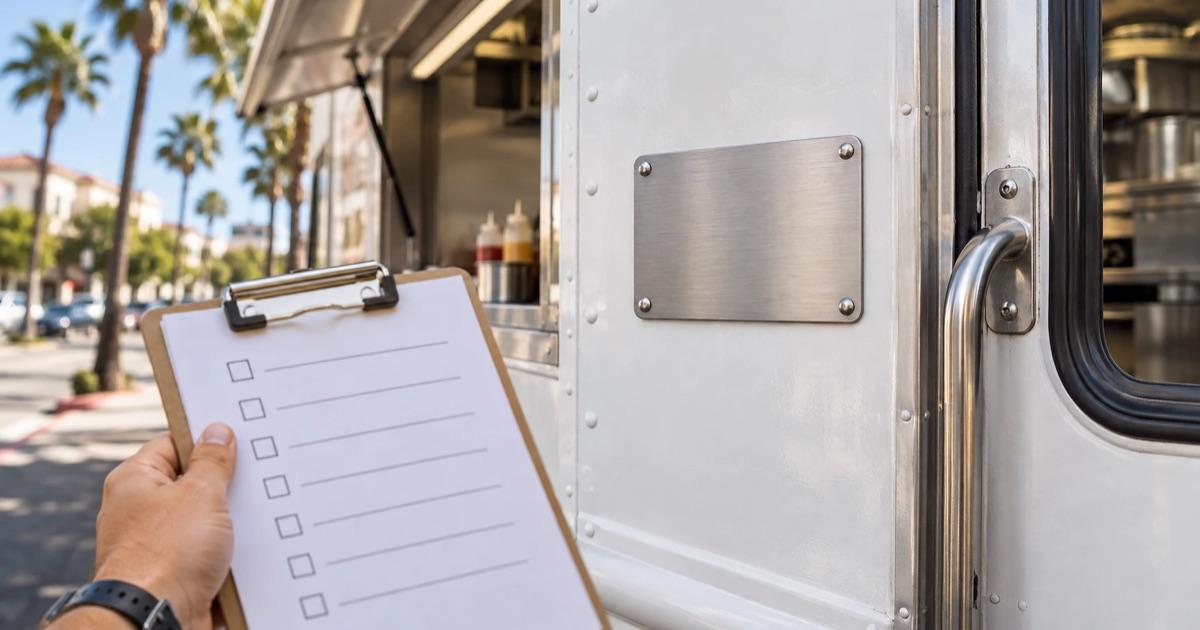
You found a food truck you like, the price is right, and the seller says it is "ready to go." Then your county environmental health office asks one question — does it have an HCD insignia? — and everything stops.
The HCD insignia is the step California food truck owners most often learn about too late. This guide covers exactly what it is, who needs one, what it costs in 2026, and how to get one for a new, used or out-of-state unit. Every rule below is taken from the statute and from HCD's own bulletin, and each is linked at the bottom.
Quick Answer
An HCD insignia is a metal plate from the California Department of Housing and Community Development certifying that a food truck or trailer people work inside meets state building standards. It is required before your county will issue a mobile food facility health permit.
| Question | Answer |
|---|---|
| Who needs it | Any truck or trailer designed to be occupied while operating. Unoccupied carts do not. |
| Cost | $51 insignia + $238 first inspection hour (then $109 per hour) — $289 minimum |
| Form | HCD MH 415 to request an inspection · HCD MH 416 to replace a lost plate ($83) |
| Order of approvals | DMV registration → HCD insignia → county health permit |
| Who to call | HCD at (800) 952-8356 — Northern Area Office (Sacramento) or Southern Area Office (Riverside) |
Free download · no email needed
California Food Truck Pre-Inspection Checklist (PDF)
Two pages: what to verify for the HCD insignia, the used-truck buyer checks, and the county health inspection items — with the code section beside each line.
Download the free checklistPrint it and take it with you when you view a truck or meet your inspector.
What the HCD insignia actually is
California does not treat a food truck as just a vehicle. If people stand inside it to work, state law classes it as a special purpose commercial modular (SPCM) — the same legal family as a mobile office or a factory-built classroom. The definition is short:
A special purpose commercial modular is "a vehicle with or without motive power, designed and equipped for human occupancy for industrial, professional, or commercial purposes" — and it includes a trailer coach. (Health and Safety Code §18012.5)
Because it is a structure people occupy, its wiring, gas lines, plumbing and fire safety fall under the California Building Standards Code, administered by HCD. The insignia of approval is the proof that it complied when it was approved. The California Retail Food Code then makes that proof a condition of your health permit: every mobile food facility that is a special purpose commercial modular "shall be certified by the Department of Housing and Community Development" (Health and Safety Code §114294(c)).
You will also hear it called the HCD sticker, HCD tag, HCD plate or HCD certification. They all mean the same plate.
What it looks like and where to find it
It is a small metal plate fixed to the outside of the unit beside the entry door. It reads "State of California, Department of Housing and Community Development, Division of Codes and Standards," carries the letters SPCM and a serial number, and states that it remains the property of the State. If the plate is missing or unreadable, expect your county to treat the unit as uncertified until HCD confirms otherwise. Removing an insignia without HCD approval is unlawful.
Who needs an HCD insignia — and who does not
The test is occupancy, not whether it has an engine.
| Your unit | HCD insignia? | Why |
|---|---|---|
| Motorized food truck you cook or serve inside | Yes | Designed for human occupancy |
| Towed concession or food trailer you stand inside | Yes | The definition covers units “with or without motive power” |
| Coffee, dessert or bar trailer with staff inside | Yes | Occupied, regardless of menu |
| Converted van, bus, step van or shipping container on wheels | Yes | A conversion is an existing unit HCD has never approved |
| Pushcart, hot dog cart, ice-cream cart, compact mobile food operation | No | The operator works beside it, not inside it |
| Truck already carrying a legible HCD insignia | Already done | Verify the serial number, then go to the county |
Borderline units
Walk-up trailers with a service counter, open-sided units and carts with a canopy are judged case by case. Get the answer from your county environmental health office in writing before you build or buy — the answer changes the cost of the project.
The three approvals, in order
HCD's Information Bulletin 2021-04, written specifically for mobile food facilities, sets out three approvals "in general order." Skipping ahead is how owners lose non-refundable county fees.
- 1DMVRegister the truck or trailer as a vehicle.Proof: Registration card and plates
- 2HCDGet the insignia of approval: the unit meets California building standards for a special purpose commercial modular.Proof: Metal insignia plate on the unit
- 3County environmental healthPlan check, equipment approval and inspection as a mobile food facility under the California Retail Food Code.Proof: Health permit and decal
One more point from the same bulletin matters if a city tells you otherwise: HCD's construction standards for these units are preemptive. Local building ordinances do not apply to the design and construction of the truck body. Local health rules still apply in full to how you handle food.
How to get the insignia: three situations
1. New truck from a manufacturer
New and remanufactured units built in a factory are approved through HCD-approved third-party agencies, which review the design and inspect during production. The builder handles this and the insignia is attached before delivery. Your job is simple: write "HCD insignia attached at delivery" into the purchase contract, and look at the plate before you make the final payment.
2. Used truck that already has an insignia
Photograph the plate and note the serial number. If the plate is legible and the unit has not been altered since, you can go straight to the county. If the plate has gone missing, HCD can check whether the unit was ever issued one; if it was, apply for a replacement with form HCD MH 416 ($83).
3. Used, converted or out-of-state truck with no insignia
This is the expensive path. A unit HCD has never approved — or one undergoing "alteration, repair, conversion or change in occupancy" — is approved by an inspection performed by HCD itself.
- Call your HCD area office at (800) 952-8356 before anything else. Describe the unit and ask what documentation they want to see.
- File form HCD MH 415 (the permit and inspection application) with the fees. An application without the fee is treated as incomplete.
- Prepare the unit. Panels open, systems connected, appliance data plates visible, any drawings or builder paperwork on hand.
- Attend the inspection. The inspector checks the unit against the building standards: electrical, gas and mechanical, plumbing, and fire and life safety.
- Correct what is found and book a re-inspection if needed. Inspection time is billed by the hour.
- Receive the insignia, then take proof of it to county plan check.
| HCD office | Address | |
|---|---|---|
| Northern Area Office | 9342 Tech Center Drive, Suite 550, Sacramento, CA 95826 | NAOstaff@hcd.ca.gov |
| Southern Area Office | 3737 Main Street, Suite 400, Riverside, CA 92501 | SAOstaff@hcd.ca.gov |
HCD insignia cost in 2026
These are the amounts on HCD's published insignia fee schedule for special purpose commercial modulars:
| Fee | Amount |
|---|---|
| New insignia | $51 |
| Inspection — first hour (minimum) | $238 |
| Inspection — each additional hour | $109 |
| Inspection — additional half hour | $51 |
| Replacement insignia (form HCD MH 416) | $83 |
What that means in practice:
- Best case: a one-hour inspection that passes — $51 + $238 = $289.
- Typical conversion: a two-and-a-half-hour inspection — $51 + $238 + $109 + $51 = $449, plus a second visit if corrections are needed.
- The real cost is the corrections. Rewiring, re-plumbing gas lines or reworking a hood on a truck that was never built to California standards can run into thousands. That is the number to negotiate off the purchase price.
HCD does not publish a turnaround time, and scheduling depends on the area office's workload. Do not commit to an event date, a lease or a county plan-check appointment until the insignia is on the truck. For county permit fees on top of this, see our California food truck permit guide and the 50-state permit cost comparison.
HCD insignia vs mobile food facility permit
These are two different approvals from two different agencies, and you need both. The insignia says the vehicle is safe to stand in. The mobile food facility (MFF) permit says the food operation is safe to eat from.
| HCD insignia | Mobile food facility permit | |
|---|---|---|
| Issued by | State — HCD, or an HCD-approved third-party agency | County or city environmental health |
| Law | Health and Safety Code Division 13, Part 2; Title 25 regulations | California Retail Food Code (CalCode), Chapter 10 |
| What is checked | Electrical, gas and mechanical, plumbing, fire and life safety of the unit | Sinks, water and waste tanks, refrigeration, surfaces, food handling, commissary, operator knowledge |
| When | Once, at approval — and again if the unit is altered | Plan check before opening, then routine inspections |
| Renewal | No annual renewal | Annual permit fee |
| Valid where | Statewide | Only in the issuing jurisdiction |
The usual path to the MFF permit, once the insignia is on the unit:
- Plan check. Submit scaled drawings, equipment specification sheets and your full menu to county environmental health.
- Commissary agreement. A signed agreement with an approved commissary where the unit is serviced and stored. See commissary requirements.
- Written operating procedures. How you keep food cold and hot, wash hands, clean and sanitize, and handle waste.
- Food safety certification. A certified food protection manager, and food handler cards for staff.
- Vehicle inspection by the county, then the permit and decal.
Have the paperwork ready for step 3
Counties expect written procedures and logs, not just a clean truck. AuditBinder builds the binder — procedures, temperature logs and checklists — in the format inspectors look for.
Buying a used food truck: seven checks before you pay
- Find the plate. Outside, beside the entry door. No plate, no deal at the asking price.
- Read the serial number and photograph it. Call HCD to confirm it belongs to this unit.
- Ask what has changed since approval. A new fryer, a different generator or a moved sink is an alteration. The insignia certifies the unit as it was approved.
- Ask for the last county health permit and inspection report. A truck permitted in a California county recently is a far safer purchase.
- Treat out-of-state trucks as uncertified. Another state's approval does not transfer.
- Get a written quote for corrections from a builder who works to HCD standards, before you agree a price.
- Make the sale conditional. "Subject to HCD insignia being issued" protects your deposit.
California food truck inspection checklist
Once HCD is done, the county inspects the food side. These are the items inspectors check first on a mobile food facility, with the CalCode section for each. Your county's plan-check guide is the final authority.
| Item | What the inspector looks for | CalCode |
|---|---|---|
| HCD insignia | Legible plate on any occupied unit | §114294(c) |
| Handwashing sink | A dedicated sink at least 9 × 9 × 5 inches, separate from the warewashing sink and easy for staff to reach | §114311 |
| Warewashing sink | Three compartments with two metal drainboards wherever unpackaged food is cooked or prepared on board | §114313 |
| Wastewater tank | Capacity at least 50% greater than the potable water tank, plus extra where water is used in food or drinks | §114240 |
| Cold and hot holding | Cold food at 41°F or below, hot food at 135°F or above, with a thermometer in every unit | §113996 |
| Commissary | Operates from, and is stored at, an approved commissary or other approved facility | §114295 |
| Identification | Business name in letters at least 3 inches high, plus city, state and ZIP at least 1 inch high, on the customer side — on two sides for motorized units | §114299 |
| Safety equipment | First-aid kit in an enclosed case, and a charged 10 BC-rated fire extinguisher mounted inside any unit with cooking or heating equipment | §114323 |
| Restroom access | Toilet and handwashing facilities within 200 feet when stopped for more than an hour | §114315 |
The daily habits that keep you passing — temperature checks, sanitizer tests, commissary records — are covered in how to pass a food truck health inspection and the free food truck temperature log.
Sources
- HCD Information Bulletin 2021-04 (MH), Special Purpose Commercial Modular — Mobile Food Facilities — hcd.ca.gov
- HCD Insignia page and fee schedule — hcd.ca.gov
- Health and Safety Code §18012.5, definition of special purpose commercial modular — California Legislative Information
- Health and Safety Code §114294, mobile food facilities and HCD certification — California Legislative Information
- Health and Safety Code §114240, wastewater tank capacity — California Legislative Information
- Plan Check Guidelines for Mobile Food Facilities and Mobile Support Units — Los Angeles County Department of Public Health
On This Page
Next: the health permit
The county wants written procedures and logs. Get the binder ready before plan check.
See the food truck binderFrequently Asked Questions
The bottom line
You work inside it → it needs an HCD insignia, truck or trailer.
It has a legible plate and has not been altered → go to the county.
No plate → call HCD, file HCD MH 415, budget $289 minimum plus corrections.
Then → plan check, commissary, written procedures, health permit.
Sort out the insignia first and the rest of the California process is paperwork you control. Leave it until last and it can hold your opening date for months.
Reminder: This guide is for information only and is not legal advice. Fees, forms and procedures change, and HCD and your county environmental health department have the final say. Confirm every requirement with them before you buy, build or pay. See our full disclaimer.
Insignia done? Get inspection-ready.
AuditBinder generates the food safety binder your county inspector asks for — written procedures, temperature and sanitizer logs, and checklists built for mobile units. One-time purchase, instant download, no subscription.
Build your food truck binder