Food Cooling Log: The Free Printable Form,
and the 2026 Rules Behind It
A two-page cooling log you can print today, the exact wording of the FDA Food Code cooling limits, and the two changes the 2026 edition made to how you are allowed to cool.
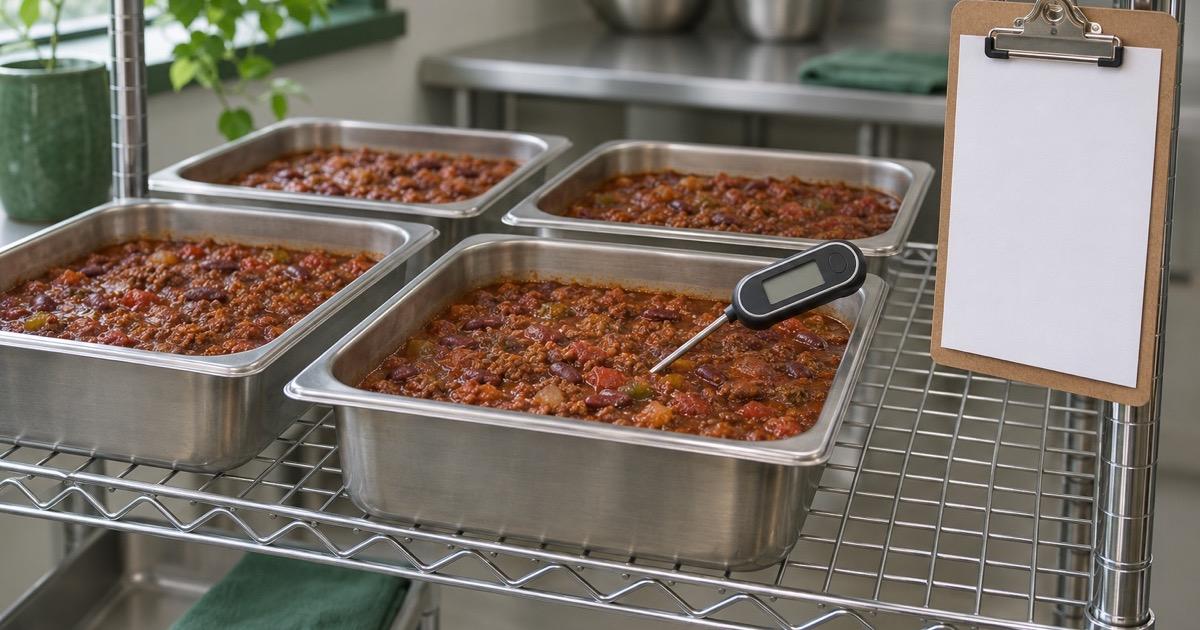
You cooked a big batch of chili, rice or pulled pork, put it in the walk-in, and served it the next day. The inspector cannot tell from the cold container whether it took five hours or fifteen to get there. The log is the only thing that can.
This page gives you a printable cooling log, the cooling limits in the words the FDA Food Code actually uses, and the two changes the 2026 edition made to cooling methods in September 2026. Every number here comes from the Code or from a named health department, with links so you can check each one.
Quick Answer
Cooked food must drop from 135°F to 70°F within 2 hours, and reach 41°F within 6 hours total from the start of cooling. A cooling log records the start time and a temperature at each checkpoint, so you can show the times were met; cooling is a Priority item in the Food Code, so an inspector can cite it immediately.
| Stage | What has to happen |
|---|---|
| Stage 1 | 135°F → 70°F (57°C → 21°C) within 2 hours |
| Stage 2 | Down to 41°F (5°C) within 6 hours in total, counted from 135°F |
| Room-temperature prep | Food made from ambient ingredients (canned tuna, reconstituted mixes) → 41°F within 4 hours |
| Code section | FDA Food Code 2026, § 3-501.14(A) and (B) |
Free download · no email needed
Food Cooling Log 2026 (free PDF)
Two printable pages: a cooling log with the 2-hour and 6-hour checkpoints marked, a worked example row, the corrective-action rules, and a cooling method checklist to tick.
Download the cooling logPrint it, clip it inside the walk-in door, and start a row the moment food passes 135°F.
How long can food take to cool? The 2-hour and 6-hour limits
The FDA Food Code sets two clocks for cooked food, and both run from the moment the food passes 135°F (57°C) on the way down. This is § 3-501.14 of the 2026 edition:
| Code section | What it requires | Applies to |
|---|---|---|
| § 3-501.14(A)(1) | Within two hours from 57ºC (135ºF) to 21ºC (70ºF) | Cooked TCS food |
| § 3-501.14(A)(2) | Within a total of six hours from 57ºC (135ºF) to 5ºC (41ºF) or less | Cooked TCS food |
| § 3-501.14(B) | Cooled within four hours to 41°F or less | Food prepared from ingredients at ambient temperature, such as reconstituted foods and canned tuna |
| § 3-501.14(C) | Cooled within four hours to 41°F or less | Food received warm under a shipping allowance from the supplier |
| § 3-501.14(D) | Placed immediately in refrigeration holding 45°F ambient or less | Raw shell eggs |
The six hours is a total, not a second four-hour window bolted onto the first stage. The Code's own commentary in Annex 3 makes the point with an example: cool from 135°F to 70°F in one hour and you have five hours left for the rest. Take three hours to reach 70°F and reach 41°F at the six-hour mark anyway, and the hazard may not have been controlled — because the food sat in the range where bacteria multiply fastest.
Why stage one carries the weight: Annex 3 explains that a long time near 70°F to 125°F is what has to be avoided, and that excessive cooling time has been "consistently identified as one of the leading contributing factors to foodborne illness". Cooking kills most pathogens but not spore-formers such as Clostridium perfringens and Bacillus cereus, which is exactly what slow cooling wakes up.
Cooling carries a P marking in the Code, meaning a Priority item: the most serious class of violation, and one an inspector can write up on the day. The cooling methods provision, § 3-501.15, is marked Pf — a Priority foundation item, the paperwork-and-practice support for it. You can see how that plays out on inspection reports in our guide to the most common critical violations.
What the 2026 Food Code changed about cooling
FDA published the 2026 Food Code on 17 September 2026, the first full edition since 2022. The cooling time limits did not change. The cooling methods did, in two ways — both in § 3-501.15.
1. Two-inch depth is now a listed method. The accepted methods in § 3-501.15(A) used to end at adding ice as an ingredient, followed by "other effective methods". The 2026 edition inserts a new sub-paragraph (A)(7), "placing the food at a depth of no more than 2 inches", and renumbers the old catch-all as (A)(8). Annex 3 says the addition reflects recent studies and that one or more methods should still be used together.
2. There is a new approved alternative process. A new § 3-501.15(C) lets a food establishment cool cooked TCS food a different way if approved by the regulatory authority that issued its permit. All of the following must hold:
| Condition in § 3-501.15(C) | Detail |
|---|---|
| Depth | Filled no more than two inches deep |
| Cover | Held uncovered |
| Unit temperature | Refrigeration maintaining ambient 41°F (5°C) or less |
| Monitoring | An electronic system that continuously monitors time and ambient air temperature |
| Approval | Written approval from your regulatory authority before you use it |
This one is worth understanding before you ask for it. The alternative drops product temperatures altogether and relies on the ambient air of a monitored unit — which is why it needs approval, and why Annex 3 tells regulators to check your equipment capacity, your monitoring system, your written procedures and your staff training first. It came from a Conference for Food Protection recommendation at the 2025 meeting.
The alternative method is barred from three processes
Annex 3 states it may not be used with non-continuous cooking of raw animal food (§ 3-401.14), reduced oxygen packaging without a variance (§ 3-502.12), or time as a public health control (§ 3-501.19). If you vacuum-seal or sous-vide, you stay on product temperatures — see our sous vide and ROP guide and the variance request walkthrough.
One caution that applies to every number on this page: the Food Code is a model, not law. Your state or county adopts an edition on its own timetable, so the rules in force for you may still be the 2022 or 2017 text. Ask which edition your health department has adopted before you rely on the 2026 additions. What the 2026 edition changed for food trucks covers the rest of it.
How to fill in a cooling log an inspector will accept
A cooling log has one job: to show the time the food passed 135°F and enough temperatures afterwards to prove both checkpoints were met. Health departments that publish their own form — Minneapolis is one — lay the columns out like this, and the free PDF above follows the same shape.
| Column | What goes in it | Why the inspector looks at it |
|---|---|---|
| Date and food | The batch, named the way your staff name it | Ties the row to a production record |
| Time at 135°F | The clock time cooling started | Both limits are counted from here |
| Temp at 1 hour | Reading from the thickest part | Early warning that the method is not working |
| Temp at 2 hours | Must be 70°F or below | The checkpoint that decides most of these |
| Temps at 3–6 hours | Readings as cooling continues | Shows the second stage was watched, not assumed |
| Temp at 6 hours | Must be 41°F or below | Closes the record |
| Corrective action | Reheated, discarded, method changed — and when | Proves you acted rather than hoped |
| Initials and verification | Who logged it, who checked it later | Verification is a HACCP principle in its own right |
Here is what a completed pair of rows looks like. Cedar Street Chili Co. is a made-up food truck, used here only to show the numbers moving:
| Batch | At 135°F | 1 hr | 2 hr | 4 hr | 6 hr | Action taken |
|---|---|---|---|---|---|---|
| Beef chili, 4 gal, split into 4 shallow pans 2 in deep, uncovered | 2:10 p.m. 135°F | 3:10 p.m. 84°F | 4:10 p.m. 62°F ✓ | 6:10 p.m. 47°F | 8:10 p.m. 39°F ✓ | None needed. Covered and dated at 8:10 p.m. |
| Rice, 2 gal, left in the original pot | 2:30 p.m. 135°F | 3:30 p.m. 104°F | 4:30 p.m. 86°F ✗ | — | — | Missed 70°F at 2 hours. Discarded at 4:35 p.m. per our written procedure; pot depth changed to 2 in pans for the next batch. |
Two habits make the difference between a log that passes and a log that gets questioned. Take the reading before the checkpoint rather than after it, so you still have time to act. And record the correction in the same row, with the time — a row that shows a failure and a documented response is stronger evidence of control than a page of perfect numbers.
Blank rows and identical numbers both look bad
A log where every batch hits 69°F at exactly two hours reads as filled in from memory at the end of the shift. So does a log with the 1-hour and 4-hour columns always empty. Inspectors have read thousands of these.
Your cooling log is one form out of about thirty
AuditBinder builds the whole binder from your answers: hazard analysis, CCP limits, and the monitoring logs that match them — including cooling.
What to do when a batch misses the 2-hour mark
The Food Code states the limits but does not name a corrective action for food that breaks them, which is why kitchens get conflicting advice. Your regulator decides, and the rule they apply is usually written down somewhere you can read. The Minneapolis Health Department prints theirs on the cooling log itself:
| Situation | Minneapolis Health Department rule |
|---|---|
| Still above 70°F, but under 2 hours | May be reheated to 165°F — only if the reheating is done before two hours |
| Above 70°F after 2 hours | Must be discarded, to prevent illness from spore-forming bacteria |
| Not at 41°F or below by 6 hours | Must be discarded |
If reheating is permitted where you are, the reheat itself has its own limits: § 3-403.11(A) requires all parts of the food to reach 165°F (74°C) for 15 seconds, and § 3-403.11(D) requires reheating to be done rapidly, with no more than two hours spent between 41°F and that temperature. Then the cooling starts again — and it should start with a different method than the one that just failed, since reheating does not make a four-inch-deep pot cool any faster the second time.
Settle this before it happens. Ask your health department, in writing, which of the two rules applies to you, and put the answer in your plan as the corrective action for the cooling step. An operator who can show the inspector a written rule and a log that follows it is in a different conversation than one deciding on the spot.
This is also the point of monitoring rather than paperwork for its own sake. In the CDC EHS-Net study of 420 restaurants, 41% of kitchen managers said they did not monitor time or temperature during cooling, and 86% described cooling processes that left out at least one FDA-recommended component. Nothing in the study is about dishonest operators; it is about kitchens that are busy and have no form in front of them.
Cooling on a food truck or trailer
A truck is the hardest place to cool food properly: small reach-ins designed to hold cold, not pull heat out, and no walk-in to spread shallow pans in. Regulators know it, and several would rather you did not cool on board at all.
Oregon states the position plainly. A mobile unit may not cool TCS food unless one of three conditions is met:
- The food is cooled in a licensed commissary; or
- Commercial refrigeration equipment is provided on the unit; or
- Written cooling procedures are prepared in advance by the operator and approved by the regulatory authority before cooling on the unit. The person in charge must then keep cooling logs, maintained on the unit for 90 days and available during inspections.
That third option is the one most trucks end up on, and it tells you what the paperwork is for: the written procedure gets you permission, and the log keeps it. If you cook off chili or braises for the next service, expect the cooling log to come up at your permit inspection. Our commissary HACCP requirements guide covers the first option, and the food truck temperature log covers the daily holding temperatures that sit alongside this one.
The simplest fix is not cooling at all
Cook what you will sell, hold it hot at 135°F or above, and the cooling clock never starts. Batch size is a food safety control as much as a kitchen decision.
Your state may already be ahead of the 2026 Code
Two states show how far the wording can drift from the federal model. Washington already makes the shallow-layer method the primary route rather than an option, and Oregon publishes the two-inch layer as a full alternative to the two-stage times.
| Jurisdiction | How cooling is framed | Checked |
|---|---|---|
| FDA Food Code 2026 | Two-stage times in § 3-501.14; eight listed methods in § 3-501.15(A), now including 2-inch depth; approved alternative in § 3-501.15(C) | November 2026 |
| Washington (WAC 246-215-03515) | Cooling in equipment must be uncovered in a shallow layer of two inches or less (or up to four inches for intact meat not touching); the 2-hour/6-hour times apply to the alternative methods | November 2026 |
| Oregon (OAR 333-150-0000, Fact Sheet 31) | Two-tier cooling or shallow-layer cooling, both accepted; specific conditions for mobile units, including 90-day cooling logs on the unit | Fact sheet dated January 2026 |
The practical reading: the two-stage times are the safe assumption everywhere, the method you use is where local wording differs, and anything described as an "alternative" needs your regulator's approval in writing. For the rest of the numbers your team needs at the line, the safe food temperature chart puts cooking, holding, cooling and reheating on one printable page, and the daily temperature log covers fridge, freezer and hot-holding checks.
Sources
- FDA Food Code 2026, § 3-501.14 Cooling and § 3-501.15 Cooling Methods (Chapter 3, pp. 70–72) and Annex 3 public health reasons — U.S. Food and Drug Administration
- Summary of Changes in the 2026 FDA Food Code (new § 3-501.15(A)(7) and ¶ (C)) — FDA
- FDA Releases 2026 Food Code, constituent update, 17 September 2026 — FDA
- Cooling Log form and corrective-action rules — Minneapolis Health Department
- Food Code Fact Sheet #31: Cooling, January 2026, including mobile unit conditions — Oregon Health Authority
- WAC 246-215-03515, cooling — Washington State Legislature
- Brown LG et al., "Restaurant Food Cooling Practices", Journal of Food Protection 2012;75(12):2172–2178, CDC EHS-Net, 420 restaurants — CDC Stacks
- Cooling Methods Fact Sheet — Texas Department of State Health Services
On This Page
Logs that match your plan
AuditBinder writes your hazard analysis and prints the monitoring forms that go with it — cooling included.
Build my binderFrequently Asked Questions
The bottom line
You cook ahead and chill → print the log, start a row at 135°F, and read the food before the 2-hour mark.
A batch misses 70°F at 2 hours → follow the rule your health department has in writing; in many places that means discarding it.
You want the new 2-inch alternative → ask your regulator first; § 3-501.15(C) needs approval, uncovered pans and continuous electronic monitoring.
You cool on a truck → check whether your state requires approved written procedures and logs kept on board.
Cooling is the step most often done well and documented badly. The form costs nothing and is the only part an inspector can see hours later.
Reminder: this is general information based on the FDA Food Code 2026 and the named state and city sources, not legal advice. Your jurisdiction may have adopted an earlier edition or added its own rules, and your regulator has the final say. See our full disclaimer.
Every log your plan asks for, in one binder
AuditBinder turns your answers into a complete HACCP binder — flow diagram, hazard analysis, CCP limits and the monitoring forms that match them. One-time purchase, instant download, no subscription.
Build my HACCP binder