Food Truck Health Code Requirements:
What the 2026 Food Code Actually Says
The sink counts, tank sizes and finish rules a health department checks before it issues your permit — with the Food Code section behind each one, so you can look it up yourself.
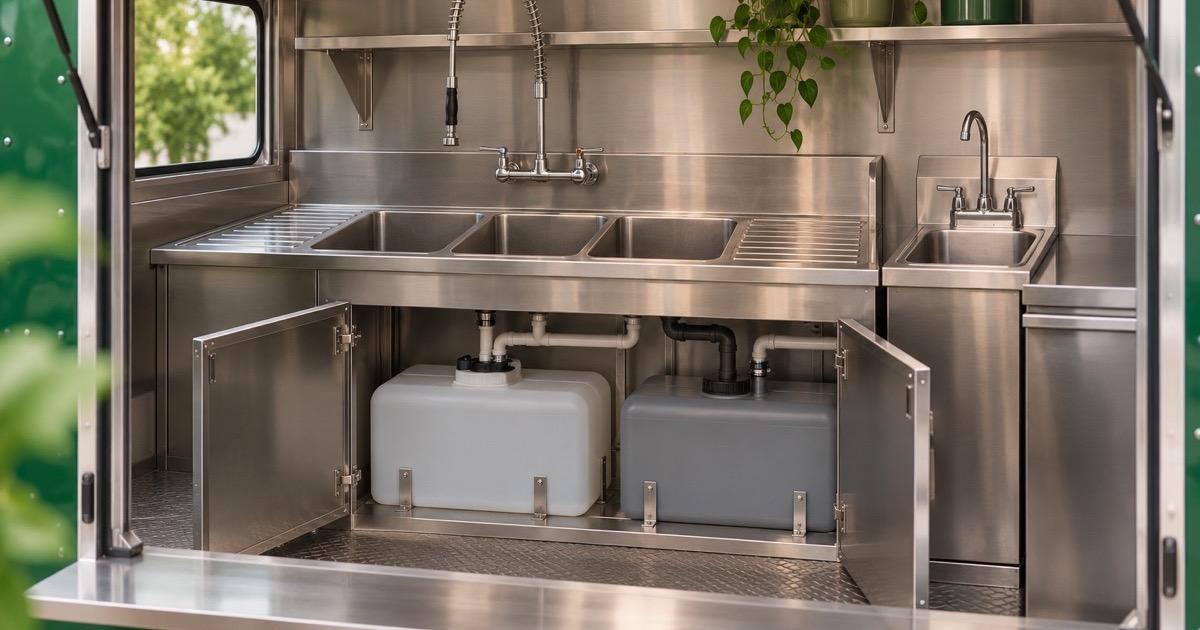
You are about to build a truck, buy a used one, or hand drawings to a health department, and somebody has asked whether it meets code. The answers you find online are usually a list of vague advice with no citation, or a single county's handout that may not apply to you.
This page gives the actual requirements from the 2026 FDA Food Code, with the section number next to each one so you can check it against the edition your own jurisdiction enforces. Everything below was read from FDA's published Food Code, not summarised from another blog.
Quick Answer
A food truck is a mobile food establishment, and the Food Code requires it to carry its own water, its own waste tank, a dedicated handwashing sink and a warewashing sink with at least three compartments. The numbers that fail plan check most often are the tank sizes: your waste tank must be 15% larger than your fresh water tank.
| What the inspector checks | The rule |
|---|---|
| Handwashing sink | At least one, used for nothing else — § 5-203.11(A) |
| Warewashing sink | Three compartments minimum — § 4-301.12(A) |
| Waste water tank | 15% larger than the fresh tank — § 5-401.11(A) |
| Waste tank drain | 1 inch or wider, with a shut-off valve — § 5-401.11(B) |
| Fresh water inlet | ¾ inch inner diameter or less — § 5-303.13 |
| Waste disposal | At an approved servicing area — § 5-402.14 |
Free download · no email needed
Food Truck Health Code Checklist (2026)
Two pages. Every requirement below as a tick-box, with the Food Code section printed next to it and blank lines for your own tank sizes and commissary details.
Download the free PDFPrint it and walk the truck with it before you book your inspection. No email required.
What counts as a mobile food establishment
The 2026 edition of the Food Code, published by FDA in September 2026, is the first to define the term on its own. A mobile food establishment is:
“a food establishment that is operated from a movable, motor-driven, mechanically, electrically, manually, or otherwise propelled vehicle, portable structure, or watercraft that can change location and moves as part of its routine operation.”
That wording is deliberately wide. A box truck, a towed trailer, a hand-pushed cart, a coffee bike and a boat are all the same category. If you have been looking for rules written specifically for a trailer and finding only truck pages, this is why: the code does not separate them. What differs between a truck and a trailer is vehicle licensing and state structural rules, not the plumbing and sink requirements on this page.
One exception worth knowing: the Food Code's definition of a food establishment excludes an operation that offers only prepackaged food that is not time/temperature control for safety food. A cart selling nothing but sealed candy may fall outside the Food Code — though your city can still require a vending permit.
Which requirements apply to your truck depends on your menu
This is the part most food truck articles miss. The Food Code includes a Mobile Food Establishment Matrix (Chart 4-D, in Annex 7) that FDA describes as “a plan review and inspectional guide for mobile food establishments based on the mobile unit's menu and operation”. You read down the column that matches what you sell.
| Area | TCS menu, prepared on board | TCS menu, prepackaged only | Non-TCS menu, prepared on board |
|---|---|---|---|
| Water & sewage | 5-104.12 · 5-203.11(A) · Part 5-3 · 5-401.11 · 5-402.13–.15 | 5-104.12 · 5-203.11(A) · Part 5-3 · 5-401.11 · 5-402.13–.15 | 5-104.12 · 5-203.11(A) · Part 5-3 · 5-401.11 · 5-402.13–.15 |
| Equipment | Parts 4-1 to 4-9 · Part 5-5 | Parts 4-1 to 4-2 · Part 4-6 · Part 5-5 | Parts 4-1 to 4-2 · Parts 4-5 to 4-6 · Part 5-5 |
| Temperature | 3-202.11 · Parts 3-4 and 3-5 | 3-202.11 · 3-501.16 | None |
| Physical facility | 6-101.11 · 6-201.11 · 6-102.11(A) & (B) · 6-202.15 · 6-501.11 · 6-501.12 · 6-501.111 | 6-101.11 · 6-102.11(A) & (B) · 6-202.15 · 6-501.111 | 6-101.11 · 6-201.11 · 6-102.11(A) & (B) · 6-202.15 · 6-501.11 · 6-501.12 · 6-501.111 |
| Servicing | 6-202.18 · as necessary to comply | 6-202.18 · as necessary to comply | 6-202.18 · as necessary to comply |
Look along the first row. The water and sewage requirements are identical in every column. A truck that only hands over sealed sandwiches needs the same fresh tank, waste tank, handwashing sink and servicing arrangement as a truck cooking to order. That single fact is behind a large share of failed plan checks, because operators assume a simple menu means simple plumbing.
The matrix is a guide, not the whole code
FDA says plainly that mobile units “may also be subject to all Food Code provisions that apply to food establishments”. The matrix tells you where to start, not where to stop.
Water and waste tanks: the numbers that fail plan check
These are the specific, checkable figures in the Food Code. They are also the ones that are expensive to get wrong, because correcting them on a finished build means pulling tanks out.
| Requirement | What the Code says | Section |
|---|---|---|
| Waste tank capacity | Sized 15 percent larger in capacity than the water supply tank | 5-401.11(A) |
| Waste tank drain | Sloped to a drain 25 mm (1 inch) inner diameter or greater, with a shut-off valve | 5-401.11(B) |
| Fresh water inlet | 19.1 mm (three-fourths inch) inner diameter or less, with a connection that cannot be used for anything else | 5-303.13 |
| Water source | Bottled water, closed portable containers, an enclosed vehicular tank, an on-premises storage tank, or hoses from an adjacent approved source | 5-104.12 |
| Hoses | Safe, durable, corrosion-resistant, nonabsorbent, smooth inside, and clearly identified if not permanently attached | 5-302.16 |
| Dedicated use | The tank, pump and hoses used for drinking water may be used for no other purpose | 5-304.14 |
| Flushing | Flushed and sanitized before service after construction, repair, modification and any period of non-use | 5-304.11 |
| Covers | A cap and keeper chain, closed cabinet, closed storage tube or other approved cover for the inlet, outlet and hose | 5-303.12 |
| Compressed air | If air pressurises the tank, a filter that does not pass oil or oil vapours goes in the supply line | 5-303.11 |
| Emptying waste | Removed at an approved waste servicing area, or by a sewage transport vehicle | 5-402.14 |
Work out your own pair: multiply your fresh water tank by 1.15 and round up. A 40-gallon fresh tank needs at least a 46-gallon waste tank; a 60-gallon fresh tank needs at least 69. The Food Code sets no minimum fresh tank size — that figure comes from your state or county, and it is one of the biggest differences between jurisdictions.
Do not assume your builder knows your county
Truck builders work across state lines and build to a general spec. The fresh tank size, the number of sink compartments and whether a separate prep sink is required are all set locally. Get your health department's mobile requirements sheet in writing before the build starts, not after.
The plumbing passes. Now they want the paperwork.
Most plan checks also ask for written procedures and logs. AuditBinder builds that binder for your menu and equipment.
What sinks does a food truck need?
The Food Code separates handwashing from warewashing, and an inspector will treat a handwashing sink used for rinsing produce as a violation rather than a technicality.
| Sink | Food Code requirement |
|---|---|
| Handwashing | At least one, conveniently located for employees — § 5-203.11(A) |
| Warewashing | At least three compartments for wash, rinse and sanitize — § 4-301.12(A) |
| Two-compartment | Only with prior approval, limited items and batch operations — § 4-301.12(C)–(E) |
| Drainboards | Racks or tables big enough for soiled and cleaned items — § 4-301.13 |
| Service sink | One service sink or curbed cleaning facility for mop water — § 5-203.13 |
The three-compartment sink must be large enough to immerse the largest piece of equipment you use (§ 4-301.12(B)). If a sheet pan or a stock pot will not fit, the Code expects you to carry a warewashing machine or use approved alternative equipment instead — which in practice usually means washing that item at the commissary.
The service sink in § 5-203.13 is the one people forget. On a small unit it is often satisfied at the commissary rather than on board, but it has to exist somewhere, and the health department will ask where.
The unit itself: surfaces, openings and screens
Chapter 6 covers the body of the truck. These are short rules, but they are the ones that generate correction notices on a first inspection.
| Rule | Section |
|---|---|
| Exterior surfaces of mobile food establishments must be weather-resistant | 6-102.11(B) |
| Floors, walls and ceilings smooth and easily cleanable | 6-201.11 |
| Outer openings protected against insects and rodents | 6-202.15 |
| Outdoor walking and driving areas surfaced to prevent dust and mud | 6-102.11(A) |
| Premises, structures and fixtures kept in good repair | 6-501.11, 6-501.12 |
“Outer openings protected” is the service window. Screens, air curtains or keeping the window closed when not actively serving all satisfy it, and which one your inspector accepts is a local judgement worth asking about in advance rather than arguing about on the day. Our guide to common critical inspection violations covers what happens when these turn into repeat findings.
Commissary and servicing area
The Food Code defines a servicing area as “an operating base location to which a mobile food establishment or transportation vehicle returns regularly for such things as vehicle and equipment cleaning, discharging liquid or solid wastes, refilling water tanks and ice bins, and boarding food”.
Two rules attach to it. Waste has to leave the truck at an approved waste servicing area or via a sewage transport vehicle (§ 5-402.14). And an outdoor servicing area needs overhead protection, unless wastes are moved by a closed system of hoses (§ 6-202.18).
Whether you are required to have one is a local decision. FDA's own guidance says the regulatory authority's decision to require auxiliary support services such as a commissary or servicing area “should be based on the menu, type of operation, and availability of on-board or on-site equipment”. In practice most US health departments require a commissary agreement for anything beyond prepackaged sales. We cover the detail in commissary requirements and how to choose a commissary.
Does the 2026 Food Code apply to you?
Probably not yet, and this is the detail most coverage of a new Food Code gets wrong. The Food Code is a model. It is not federal law and it binds nobody until a state, county or city writes it into their own rules. Adoption usually takes years, so your health department is most likely still enforcing the 2022 edition or earlier.
That does not make this page academic. The plumbing and sink requirements above have been stable across editions, which is why they look the same in most state codes. What is new in 2026 is the named definition of a mobile food establishment — the direction state codes will follow. Our article on what the 2026 Food Code changed for food trucks goes through the rest of the changes and the adoption lag in detail.
State and county rules sit on top of the model, and they are where the numbers you actually build to come from:
| Where you operate | Start here |
|---|---|
| California | Health permit and the HCD insignia |
| Florida | Florida health permit guide |
| Texas | Texas requirements |
| New York City | NYC requirements |
| Georgia | Georgia requirements |
| North Carolina | North Carolina requirements |
| Anywhere else | Permit costs in all 50 states |
How to get through plan check first time
Plan check is the approval your health department gives to the design before the unit is built or permitted. FDA publishes the Mobile Food Establishment Matrix precisely as a plan review guide, and the Food Code points to a separate Guidelines for Mobile Food Establishment, 2025 document maintained by the Conference for Food Protection for the same purpose.
- Settle the menu first. The matrix column you fall into is set by your menu, so a menu change late in the build can change your requirements.
- Get the local sheet in writing. Fresh tank minimum, sink count, prep sink, generator and propane rules are all local.
- Size the tanks together. Fresh tank first, then waste at 1.15× and round up.
- Name the commissary. Most departments want a signed agreement before they will approve the plan.
- Bring the paperwork. Written procedures, temperature logs and an employee illness policy are increasingly part of the submission, not just the inspection.
On that last point: the logs are the part people leave until the inspector asks. A food truck temperature log and a cooling log are quick to set up and are the first two documents most departments ask to see. When the unit is built and you are preparing for the visit itself, work through the food truck health inspection checklist.
Sources
- FDA Food Code 2026, full text (PDF) — U.S. Food and Drug Administration. All section numbers and quotations on this page were read from this edition in November 2026.
- Summary of Changes in the 2026 FDA Food Code — U.S. Food and Drug Administration. Source for the new mobile food establishment definition.
- FDA Food Code Mobile Food Establishment Matrix, Chart 4-D, Annex 7, pages 632–633 of the 2026 Food Code.
- Guides and documents, including Guidelines for Mobile Food Establishment (2025) — Conference for Food Protection. Referenced by the 2026 Food Code at Annex 7, section L.
- Adoption of the FDA Food Code by State and Territorial Agencies — U.S. Food and Drug Administration. Use this to find which edition applies where you operate.
On This Page
The documents they ask for
Plan check approves the build. The binder covers the procedures, logs and policies that come next.
See what is includedFrequently Asked Questions
The bottom line
Still drawing the build → size the waste tank at 1.15× the fresh tank and confirm the local fresh tank minimum in writing.
Buying a used truck → measure both tanks and count the sink compartments before you pay, not after.
Selling prepackaged only → you still need the full water, waste and handwashing setup.
Heading to plan check → bring the menu, the commissary agreement and your written procedures together.
None of this guarantees approval. The health department that issues your permit decides, and its edition of the code is the one that counts — but arriving with the right numbers and the section behind each one is what turns a plan check into a formality.
Reminder: this is general information based on the FDA Food Code, not legal advice. The Food Code is a model; your state, county or city rules are what bind you, they may differ, and the regulator has the final say. See our full disclaimer.
Your truck passes. Does your paperwork?
AuditBinder builds a complete food safety binder for your menu and equipment — written procedures, logs and policies, ready to print. One-time purchase, instant download, no subscription.
Build my food truck binder