Bakery HACCP Plan Example:
A Filled-In Plan You Can Copy (Free PDF)
Not another explanation of the seven principles. A finished plan for a real bakery product — flow diagram, hazard analysis, four CCPs, allergen matrix and a completed log — that you can read in ten minutes and adapt in an afternoon.
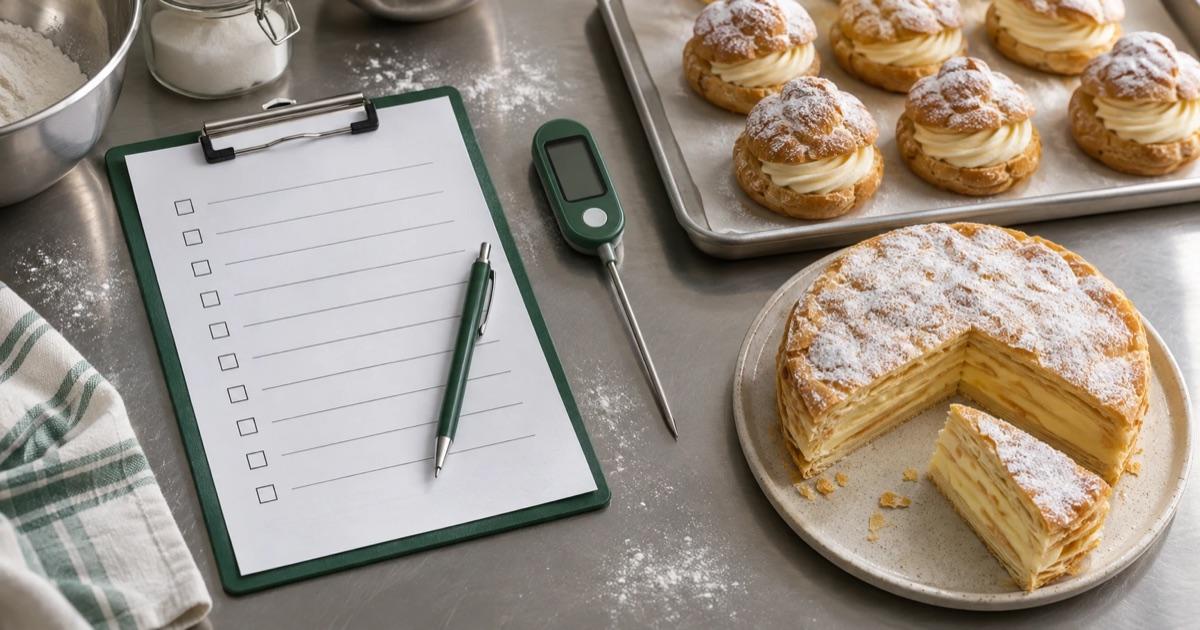
Most "bakery HACCP plan" pages tell you what a plan is. You already know that. What you need is to see one that is finished, for a product you actually sell, so you can check your own against it or build yours from it.
So this page is the plan itself. It is written for a fictional retail bakery and its highest-risk product — a custard-filled layer cake — because that one product touches every hazard a bakery has: raw flour, raw eggs, a cooked filling that must be cooled fast, cold holding, and three major allergens.
Quick Answer: what a bakery HACCP plan contains
A bakery HACCP plan has five parts: a product description, a process flow diagram, a hazard analysis, a CCP summary with critical limits, monitoring and corrective actions, and the records that prove it runs. A typical cream- or custard-filled product has four critical control points:
| CCP | Step | Critical limit |
|---|---|---|
| CCP 1 | Baking | Internal temperature 165°F (74°C) or higher |
| CCP 2 | Cooking custard / pastry cream | 165°F (74°C) or higher |
| CCP 3 | Cooling the filling | 135°F → 70°F within 2 hours, and to 41°F within 6 hours total |
| CCP 4 | Cold holding and display | 41°F (5°C) or below, date-marked |
Allergens (wheat, egg, milk, nuts, sesame) are controlled by a written allergen program that runs alongside the CCPs. The full worked example is below, and the same plan is in the free PDF.
Free download · no email needed
Bakery HACCP Plan Example (PDF)
The complete filled-in plan from this page — product description, flow diagram, hazard analysis, CCP summary, allergen matrix and a completed cooling log — formatted to print and mark up.
Download the free PDFA worked example for a fictional bakery. Use it as a structure — your own plan must describe your products, equipment and local code.
The example bakery and product
A HACCP plan is always written for a specific business and a specific product or product group. Ours:
| Plan section | Filled-in example |
|---|---|
| Business | Maple Street Bakery (fictional). Retail counter with 6 staff, plus chilled delivery to two café accounts. |
| Product | Vanilla custard layer cake — sponge layers, pastry-cream filling, whipped-cream finish. |
| Ingredients | Wheat flour, sugar, shell eggs, whole milk, heavy cream, butter, cornstarch, baking powder, vanilla, salt. |
| Allergens | Wheat, egg, milk. Made on equipment shared with tree nuts and sesame. |
| Food safety characteristics | Finished cake is a time/temperature control for safety (TCS) food because of the custard and cream. Baked sponge alone is not. |
| Packaging | Cardboard cake box with window; label with product name, ingredients, allergens, and discard date. |
| Storage and shelf life | Refrigerated at 41°F (5°C) or below. Sold or discarded within 3 days of assembly (the code maximum is 7). |
| Intended use | Ready to eat, no further cooking. General public, including children and older adults. |
| HACCP team | Owner (person in charge), head baker, pastry cook, front-of-house lead. |
Why one product? You do not write a separate plan for all sixty items on the menu. You group products that share the same process and hazards, then write one plan per group. This cake stands in for every cooked-filling product: éclairs, cream puffs, Boston cream pie, fruit tarts with crème pâtissière.
Process flow diagram
The flow diagram lists every step the product goes through, in order, from the delivery door to the customer. Reviewers ask for it first, and a paragraph describing the process does not count. Walk the floor with it before you finalize — the step you forget is usually the one where product waits on a rack.
- 1ReceivingFlour, sugar, dry goods · refrigerated milk, cream, butter and shell eggs
- 2StorageDry store (ambient) · walk-in cooler at 41°F or below
- 3Scaling and mixing batterAllergen control point: wheat, egg, milk
- 4Baking cake layersCenter of the layer reaches 165°F or higherCCP 1
- 5Cooling cake layersRacked at room temperature — plain baked layers are not TCS
- 6Cooking pastry creamMilk, egg yolks, sugar, starch — 165°F or higherCCP 2
- 7Cooling pastry cream135°F to 70°F in 2 hours, then to 41°F within 6 hours totalCCP 3
- 8Whipping creamMade cold from refrigerated cream; kept at 41°F or below
- 9Assembly and fillingGloved hands, sanitized tools, back under refrigeration promptly
- 10Cold holding and display41°F or below, date-marked, sold or discarded by day 3CCP 4
- 11Packaging and labelingAllergen statement checked against the recipe
- 12Sale or deliveryCounter sale, or chilled delivery to café accounts
Hazard analysis
For each step you ask three questions: what could go wrong here (biological, chemical including allergens, physical), is it likely and serious enough to be significant, and what controls it. Only significant hazards with no later step to catch them become CCPs. Everything else is handled by your everyday prerequisite programs — cleaning, supplier approval, handwashing, pest control.
| Step | Hazard | Significant? | Control measure | CCP? |
|---|---|---|---|---|
| Receiving — flour and dry goods | B: Salmonella, E. coli in raw flour. P: foreign material. | Yes — raw flour is not a ready-to-eat ingredient | Approved suppliers; controlled later at baking; flour sifted | No |
| Receiving — dairy and eggs | B: Salmonella (eggs); pathogen growth if delivered warm. | Yes | Receive dairy at 41°F or below and shell eggs from a refrigerated truck at 45°F or below; reject otherwise; receiving log | No (prerequisite) |
| Cold storage | B: growth of pathogens. | Yes | Walk-in at 41°F or below, checked and logged twice daily | No (prerequisite) |
| Scaling and mixing | C: allergen cross-contact (tree nuts, sesame, peanuts from other products). | Yes | Allergen program: production order, dedicated color-coded tools, clean-down between allergen changes | No (allergen program) |
| Baking cake layers | B: survival of Salmonella and E. coli from flour and eggs. | Yes — the only kill step for the sponge | Bake until the center reaches 165°F or higher | CCP 1 |
| Cooking pastry cream | B: survival of Salmonella from egg yolks. | Yes — the only kill step for the filling | Cook to 165°F or higher | CCP 2 |
| Cooling pastry cream | B: growth of spore-forming bacteria (Bacillus cereus, Clostridium perfringens) that survive cooking. | Yes — thick, starchy, cooled in bulk | Shallow pans, ice bath, two-stage cooling limit | CCP 3 |
| Assembly and filling | B: contamination from hands and surfaces (norovirus, Staph. aureus, Listeria). | Yes | No bare-hand contact with ready-to-eat food; handwashing; sanitized tools; product returned to the cooler promptly | No (prerequisite) |
| Cold holding and display | B: growth of Listeria monocytogenes and toxin formation. | Yes — no further kill step before the customer | Hold at 41°F or below; date mark; discard at day 3 | CCP 4 |
| Packaging and labeling | C: undeclared allergen from a wrong or outdated label. | Yes | Label checked against the current recipe at every label change | No (allergen program) |
The hazard most bakery plans miss
Raw flour. It is a raw agricultural product that has not been treated to kill bacteria, and it has caused multi-state Salmonella and E. coli outbreaks. If your hazard analysis lists eggs but not flour, a reviewer will notice.
CCP summary: the heart of the plan
This table is the part an inspector reads line by line. Each critical control point needs a single measurable limit, a named person who checks it, a stated frequency, and a specific action when the limit is missed.
| CCP | Critical limit | Monitoring | Corrective action | Verification and records |
|---|---|---|---|---|
| CCP 1 Baking | Center of the layer reaches 165°F (74°C) or higher | Baker probes the center of one layer per oven load with a calibrated thermometer; every batch | Below limit: keep baking and re-check. Oven failure: discard the load. Record what happened. | Owner reviews the bake log daily. Thermometer calibrated weekly. Records: bake log, calibration log. |
| CCP 2 Cooking pastry cream | Batch reaches 165°F (74°C) or higher (in practice it is brought to a full boil) | Pastry cook stirs, then probes the batch; every batch | Below limit: continue cooking and re-check. Record. | Owner reviews the cook log daily. Records: cook log. |
| CCP 3 Cooling pastry cream | 135°F to 70°F within 2 hours, and 41°F or below within 6 hours of starting | Pastry cook records start time and temperature, then probes at 2 hours and at 6 hours; every batch | Above 70°F at 2 hours: reheat to 165°F once and restart in shallower pans, or discard. Above 41°F at 6 hours: discard. | Owner reviews the cooling log daily and checks pan depth weekly. Records: cooling log, corrective action log. |
| CCP 4 Cold holding and display | Product at 41°F (5°C) or below; discard date no later than day 3 | Front-of-house lead reads walk-in and display case thermometers at opening, mid-day and closing; checks date labels at opening | Unit above 41°F: probe the product and move it to a working unit. If product was above 41°F for more than 4 hours, or the time is unknown, discard. Call for service. | Owner reviews the temperature log weekly. Records: refrigeration log, discard log. |
The numbers come from the FDA Food Code: 155°F for 17 seconds is the minimum for foods containing raw eggs that are not cooked to order (the example uses a more conservative 165°F), the two-stage cooling limit is §3-501.14, and 41°F cold holding with seven-day date marking is §3-501.16 and §3-501.17. The 2026 Food Code, released in September 2026, leaves these limits unchanged. Your state or county may enforce an older edition, so confirm the figures your inspector uses — our food temperature chart lists them side by side.
Want this built for your menu?
Answer a few questions about your products and process. AuditBinder generates the flow diagram, hazard analysis, CCP summary and log sheets as a print-ready binder.
Allergen matrix
In a bakery, an undeclared allergen is more likely to hurt a customer than a bacterium is. US law recognizes nine major allergens — milk, eggs, fish, crustacean shellfish, tree nuts, peanuts, wheat, soybeans and, since 2023, sesame. The UK list has 14. An allergen matrix puts every product against every allergen on one page, and it is the document your counter staff should reach for when a customer asks.
| Product | Wheat | Egg | Milk | Tree nuts | Peanuts | Sesame | Soy |
|---|---|---|---|---|---|---|---|
| Vanilla custard layer cake | ● | ● | ● | ○ | — | ○ | — |
| Almond croissant | ● | ● | ● | ● | — | ○ | — |
| Sourdough loaf | ● | — | — | — | — | ○ | — |
| Sesame bagel | ● | — | — | — | — | ● | — |
| Peanut butter cookie | ● | ● | ● | ○ | ● | — | ● |
| Baked cheesecake | ● | ● | ● | ○ | — | — | — |
The written allergen program behind the matrix has four rules:
- Production order. Allergen-free and single-allergen products are made first; nut, peanut and sesame products last.
- Dedicated tools. Color-coded scoops, bowls and trays for nuts, peanuts and sesame, stored separately.
- Clean-down at every allergen change. Wash, rinse, sanitize — a dry wipe moves flour dust, it does not remove protein.
- Label check. Whenever a recipe or supplier changes, the label and the matrix are updated before the next batch is sold.
A filled-in cooling log (including a bad day)
A plan is only believed if the logs match it. Here are two real-looking entries from the pastry-cream cooling log — one clean, one where the limit was missed and the corrective action was written down. Inspectors trust the second kind of record far more than a month of perfect numbers. If you want the blank version of this form, take the free printable cooling log.
| Date / batch | Start | 2-hour check (limit 70°F) | 6-hour check (limit 41°F) | Method | Corrective action | Initials |
|---|---|---|---|---|---|---|
| Nov 9 · PC-A | 6:40 am · 135°F | 8:25 am · 64°F ✓ | 11:50 am · 39°F ✓ | 2-inch pan, ice bath, stirred every 20 min | None needed | JM |
| Nov 10 · PC-A | 6:35 am · 135°F | 8:35 am · 74°F ✗ | — | 4-inch pan used by mistake | Reheated to 167°F at 8:45 am. Split into two 2-inch pans. Restarted: 70°F at 10:20 am, 40°F at 1:55 pm. Staff retrained on pan depth. | JM |
Blank versions of these sheets are free: the daily temperature log covers refrigeration and display cases, and the temperature log template pack includes cooking and receiving logs.
HACCP plan for cakes, bread and pastries: what each product needs
The custard cake is the hard case. Most of a bakery's range is simpler, and your plan should say so rather than invent CCPs that do not exist. Use this table to sort your menu into groups.
| Product group | TCS? | What the plan must control |
|---|---|---|
| Bread, rolls, bagels, plain cookies, muffins, unfilled sponge | No | Baking (kill step for raw flour and eggs), allergens, foreign material. No temperature control after baking. |
| Cakes with American buttercream or fondant | Usually no | As above. Confirm the icing recipe is shelf-stable — high sugar, no fresh cream or cream cheese. |
| Cakes with cream cheese frosting, meringue buttercream, ganache or fresh fruit | Yes, unless lab-tested | Cold holding at 41°F or below and date marking. A product assessment (pH and water activity) is needed to treat them as shelf-stable. |
| Custard, pastry cream, mousse and whipped-cream products | Yes | The full example on this page: cook, cool, cold hold. |
| Cheesecake, custard and pumpkin pies, quiche | Yes | Baking, cooling after baking (same two-stage limit), cold holding. |
| Sausage rolls, meat or cheese pastries | Yes | Cooking the filling to its required temperature, hot holding at 135°F or above or cooling, cold holding. |
| Anything vacuum-sealed | Yes | Vacuum packaging is reduced oxygen packaging and triggers a mandatory HACCP plan. See sous vide and vacuum sealing HACCP rules, and how to write a variance request if you fall outside them. |
Does your bakery legally need a HACCP plan?
The honest answer is that many small retail bakeries are not legally required to have one — and are asked for one anyway, by a wholesale customer, a landlord, a farmers market, or an inspector who wants your cooling procedure in writing. The legal position depends on who you sell to.
| Your bakery | What the law asks for |
|---|---|
| US retail bakery (most sales direct to customers) | Regulated by your state or local food code. No HACCP plan by default; one is required when you use a specialized process such as vacuum packaging, need a variance, or the regulator requires it. |
| US wholesale bakery (most sales to other businesses) | An FDA-registered food facility under the FSMA Preventive Controls for Human Food rule (21 CFR 117): a written food safety plan with a hazard analysis and preventive controls. Businesses averaging under $1 million a year in food sales (adjusted for inflation) can file as a qualified facility with reduced requirements. |
| US home / cottage bakery | State cottage food law. Most states limit you to shelf-stable foods, so custard and cream-filled products are not allowed from a home kitchen. |
| UK bakery, any size | Written food safety procedures based on HACCP principles are mandatory. The Food Standards Agency’s Safer Food, Better Business pack is accepted for small bakeries. Prepacked-for-direct-sale items need a full ingredient label with allergens emphasized. |
| Canadian bakery | Provincial rules for local retail. Trading across provincial borders or exporting brings you under the Safe Food for Canadians Regulations, which require a licence and preventive controls. |
Not sure which row you are in? Start with do you need a HACCP plan? and the broader bakery HACCP plan guide for wholesale and allergen rules.
Seven mistakes that get bakery plans sent back
- Copying a factory template. A plan with twelve CCPs, metal detection and a recall team tells the reviewer it was not written for your shop.
- Critical limits that cannot be measured. "Bake thoroughly" and "cool quickly" are not limits. A number and a unit are.
- No cooling step for custards. The filling goes from the stove to the walk-in in a deep bucket, and nobody records a temperature.
- No raw flour hazard. Eggs are listed, flour is not.
- Allergen control described as "we are careful". There is no matrix, no production order, no clean-down record.
- Treating every frosting as shelf-stable. Cream cheese frosting on the counter for two days, with no lab data to support it.
- Logs that do not match the plan. The plan says every batch; the log shows one entry a week.
How to adapt this example to your bakery
Step 1 — Sort your menu into groups
Use the product table above. Most bakeries end up with three or four groups, not sixty products.
Step 2 — Walk the process and draw the flow
Follow one batch from delivery to sale and write down every step, including the waiting. Have the person who actually makes it check your diagram.
Step 3 — Run the hazard analysis
At each step: what could go wrong, is it significant, what controls it. The seven principles of HACCP explain the method if you have not done one before.
Step 4 — Set limits your code supports
Use the temperatures your health department enforces. Fewer, real CCPs beat many invented ones.
Step 5 — Build the logs and the allergen matrix
One sheet per CCP, with the limit printed on it so staff see it every time they write a number.
Step 6 — Train, run it for two weeks, then fix it
The first fortnight shows which checks are unrealistic. Change the plan to match what works, sign and date it, and review it once a year or whenever the menu changes.
Doing this by hand takes most people two or three working days the first time. If you would rather not start from a blank page, AuditBinder walks you through the same six steps as a guided wizard and outputs the finished binder — a one-time purchase from $47, with no subscription. You can look at a complete sample binder first. If you are weighing that against hiring help, see what HACCP consultants charge in 2026.
Sources
- FDA Food Code, cooking (§3-401.11), cooling (§3-501.14), cold holding (§3-501.16), date marking (§3-501.17), time as a public health control (§3-501.19), HACCP plan requirements (§8-201.13) — fda.gov
- Summary of Changes in the 2026 FDA Food Code — fda.gov
- FSMA Final Rule for Preventive Controls for Human Food (21 CFR 117), including qualified facilities — fda.gov/pchfrule
- Handling Flour Safely: What You Need to Know — FDA
- Food Allergies (the nine major food allergens) — FDA
- Safer Food, Better Business — UK Food Standards Agency
On This Page
Skip the blank page
Generate this same structure for your own products — flow diagram, CCPs and logs. One-time purchase.
Build my bakery planFrequently Asked Questions
The bottom line
A bakery HACCP plan is shorter than most people expect. For a cream or custard product it comes down to four numbers and one matrix:
Bake and cook → 165°F or higher, checked every batch.
Cool → 70°F within 2 hours, 41°F within 6.
Hold → 41°F or below, date-marked.
Allergens → one matrix, one production order, one clean-down rule.
Write those down for your own products, attach the logs that prove you check them, and you have a plan an inspector can follow in five minutes.
Reminder: This is an educational example for a fictional business, not legal advice and not a plan you can submit as written. Food codes differ by state, county and country, and your regulator has the final say on your limits and records. See our full disclaimer.
Turn the example into your own plan
AuditBinder asks about your products and process, then builds the complete binder — flow diagram, hazard analysis, CCP summary and monitoring logs — ready to print. One-time purchase, instant download, no subscription.
See plans from $47